
Views: 0 Author: Site Editor Publish Time: 2026-11-05 Origin: Site


Aluminum offers superior durability and sleek aesthetics for modern fenestration projects. However, its naturally high thermal conductivity requires a flawless thermal barrier to meet today's strict energy codes. Inserting thermal break strips is not just a simple thermal upgrade. It is a highly critical structural assembly process. This procedure dictates the final shear strength and wind load resistance of the entire window or door system. We will explore the complete mechanical locking process, covering knurling, insertion, rolling, and testing. Understanding these specific steps helps procurement teams and engineers evaluate supplier reliability effectively. You will learn how to mitigate structural failure risks, maintain tight manufacturing tolerances, and ensure full code compliance across your product lines.
The assembly of thermal break strips relies on a three-step mechanical process: knurling, insertion, and rolling/crimping.
Proper knurling of the aluminum cavity is the most critical step for achieving long-term shear strength and preventing profile slippage.
Rolling requires exact pressure calibration to secure the polyamide strip without cracking the thermal barrier or warping the aluminum extrusion.
Quality control must involve rigorous longitudinal shear testing (e.g., AAMA TIR-A8 or EN 14024 standards) to verify the composite profile's structural integrity before fabrication.
The finished composite profile serves a crucial dual role in modern architecture. It must stop thermal bridging completely. At the same time, it must act as a unified structural component. When manufacturers fit the strips improperly, the risks multiply quickly. You might see composite slippage under heavy wind loads. Water ingress often follows when mechanical joints fail. Furthermore, a thermal expansion mismatch can easily lead to catastrophic seal failure. Aluminum and polyamide expand at slightly different rates. A loose structural bond cannot absorb these natural thermal movements.
Standardized fitting processes prevent these costly issues entirely. They guarantee consistent U-values across your entire product catalog. They also secure reliable structural ratings for high-rise commercial applications. This consistency reduces warranty claims significantly. It also ensures smooth compliance for localized energy regulations. You protect your brand reputation and maintain strong profit margins. Precision assembly eliminates the hidden risks of composite failure.
Knurling prepares the raw aluminum extrusion for final assembly. The objective is to create microscopic "teeth" inside the aluminum extrusion’s strip groove. Specialized knurling wheels score the aluminum cavity aggressively. This mechanical action drastically increases internal surface friction. The hardened steel wheels bite into the soft aluminum to form precise ridges.
Skipping or poorly executing this step is highly dangerous. It remains the primary cause of shear strength failure in finished profiles. Without proper knurling, the aluminum and the inserted materials will slide against each other. Thermal stress and daily temperature fluctuations constantly drive this unwanted movement. For buyers, inspecting the knurling quality is non-negotiable. Always verify your extruder uses sharp, well-maintained knurling wheels. Dull wheels merely dent the aluminum instead of cutting sharp teeth. Sharp teeth are absolutely essential for gripping the polyamide effectively.
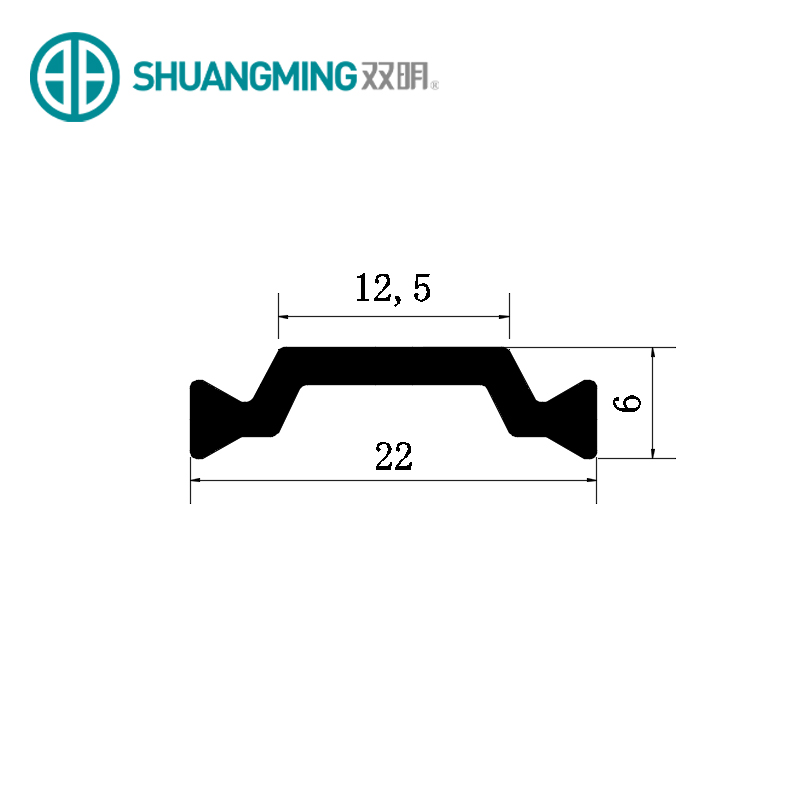
Once knurling finishes, the physical insertion phase begins. Operators or automated machines thread the rigid barriers into the freshly knurled grooves. Industry standards typically specify PA66GF25 (polyamide reinforced by 25% glass fiber) for this component. The insertion machinery smoothly handles various strip geometries. Basic I-shapes provide straightforward thermal isolation. C-shapes allow necessary clearance for complex window hardware. Hollow shapes trap stagnant air for maximum insulation performance.
Manufacturing tolerances play a massive role during this phase. The extrusion tolerances of both the aluminum cavity and the polyamide component must perfectly align. If they do not match, you face serious production bottlenecks. Tight tolerances prevent jamming during high-speed machine insertion. They also prevent excessively loose fits. A loose fit forces the rolling machine to overcompensate later. By maintaining strict dimensional control, operators ensure a smooth, continuous feed. You get a perfectly aligned composite profile ready for crimping.
Rolling and crimping permanently lock the two materials together. Heavy-duty rolling discs apply lateral pressure to the outer edges of the aluminum extrusion. This targeted force bends the metal over the dovetail of the thermal break strips. Multi-stage rolling ensures absolute precision. Manufacturers usually deploy three distinct sets of rolling discs. They apply gradual, calculated pressure across the entire profile length.
Improper pressure calibration introduces severe structural risks:
Excessive pressure cracks the rigid polyamide strip instantly.
Too much lateral force also warps the surrounding aluminum extrusion.
Insufficient pressure results in a loose, unsafe structural bond.
Uneven rolling causes the finished profile to curve or twist.
Precision calibration prevents these catastrophic structural failures. Alignment also matters deeply during this high-pressure stage. Facilities use polyurethane or protective rollers along the assembly line. These soft rollers prevent scratching the visible faces of the architectural aluminum. They guide the profile perfectly straight through the heavy steel crimping discs.
Buyers must verify the fitting quality through standardized mechanical testing. You cannot rely on basic visual inspections alone. Rigorous laboratory testing confirms the true structural composite action.
This process requires longitudinal shear testing. The test evaluates the composite profile's resistance to slipping along its central axis. Technicians clamp the profile securely and push the inner polyamide core. They apply increasing force until the layers physically shift. Reputable suppliers test their assemblies against EN 14024 or AAMA TIR-A8 standards.
Transverse tensile strength testing is equally vital for quality assurance. It ensures the crimped aluminum won't pull apart under severe wind loads. The mechanical bond must withstand massive outward push-pull forces.
Table: Primary Quality Control Tests for Composite Extrusions
Test Type |
Primary Objective |
Relevant Standards |
Failure Indicator |
|---|---|---|---|
Longitudinal Shear Test |
Measure resistance to axial slipping |
EN 14024, AAMA TIR-A8 |
Profile layers slide independently |
Transverse Tensile Test |
Evaluate pull-apart resistance |
EN 14024, AAMA TIR-A8 |
Aluminum un-crimps from dovetail |
Dimensional Tolerance |
Verify profile straightness |
ISO 2768, ASTM B221 |
Bowing, twisting, or warping |
When shortlisting suppliers, request documented shear test reports. Ask them about their specific batch testing frequency. A reliable manufacturing partner will provide this data enthusiastically. They use these metrics to optimize their own rolling pressures daily.
Conducting a supplier audit reveals the true capabilities of an extruder. Look closely at their mechanical assembly floor. You want to see pristine, well-maintained calibration equipment. Procurement teams must use strict implementation checklists.
Pay attention to these specific red flags and requirements:
Lack of dedicated knurling equipment: This is your first major check. Relying only on tight rolling is a massive red flag. Proper knurling is mandatory for long-term structural safety.
Inconsistent dimensional tolerances: Check the sample composite profiles carefully. Dimensional variations indicate poor rolling machine calibration. The machine pressure is likely fluctuating during production.
Process traceability: You must have the ability to track materials. Know exactly which batch of thermal break strips went into which specific extrusion run. Traceability isolates manufacturing defects quickly.
Never commit to large-scale procurement immediately. Always request pilot samples first. Send these samples to a third-party lab for independent shear testing. This proactive step guarantees the supplier actually meets your engineering specifications. You eliminate costly surprises before mass production begins.
The fitting process transforms two completely separate materials into a single, high-performance structural composite. Evaluating a supplier's mechanical assembly process is absolutely paramount. You must scrutinize their knurling, insertion, and rolling techniques thoroughly. This technical evaluation is just as critical as selecting the right strip material. Poor assembly practices ruin even the best polyamide components.
We highly encourage buyers to act proactively. Review your current extruders' quality assurance documentation today. Look for certified AAMA or EN shear test reports. If you spot inconsistencies, reach out to technically vetted manufacturing partners. They will help you optimize your profile design for lasting structural integrity. Proper assembly ensures your windows and doors perform flawlessly for decades.
A: Pour-and-debridge systems use liquid polyurethane. Manufacturers pour this liquid into an aluminum channel and mill out the metal bottom. In contrast, polyamide barriers require a dry mechanical process. Operators knurl the aluminum, insert the rigid strip, and crimp the metal to lock it. Polyamide systems offer higher structural rigidity and easier dual-color finishing.
A: The internal geometry changes to boost insulation performance. However, the insertion dovetail remains completely standard. This standard dovetail fits universally into standard aluminum grooves. Whether you use a flat I-shape or a complex multi-cavity hollow shape, the knurling and rolling machinery handles them identically.
A: Low rolling pressure fails to lock the composite together. You lose the crucial structural composite action. Under stress, the aluminum and polyamide layers will shear against each other. This slippage leads to severe window frame deformation, broken seals, and eventual structural failure during high wind events.
A: Yes, but sequencing matters. Polyamide easily withstands the high temperatures of powder coating ovens. Therefore, manufacturers usually insert the barriers before painting the profile. If you must fit them into pre-painted aluminum, you need extremely precise tooling. Specialized polyurethane rollers prevent the crimping discs from scratching the finished surface.


