
Views: 0 Author: Site Editor Publish Time: 2026-10-22 Origin: Site


Fenestration engineers and procurement teams face a relentless technical challenge today. They must meet increasingly stringent global building energy codes. Simultaneously, they cannot compromise the structural integrity of aluminum window and door systems. While material composition—specifically PA66GF25—dictates baseline durability, it does not tell the whole story. The physical geometry, or the profile shape, ultimately governs a delicate structural balance. It dictates thermal transmittance (Uf-value), longitudinal shear strength, and overall manufacturing efficiency on the assembly line. This definitive evaluation guide examines the most common profile shapes of polyamide thermal break strips available today. We aim to help specifiers align component geometry precisely with their project requirements. You will learn to navigate performance trade-offs and ensure system compatibility across all frame designs.
Performance Trade-offs: The profile shape directly controls the size of the insulation zone and resistance to convection; more complex shapes yield better U-values but require precise assembly.
Standard vs. Advanced: I-type and C-type shapes serve standard commercial needs, while multi-cavity, S-type, and IC-type profiles are required for high-performance or offset frame designs.
System Compatibility: Selecting the right shape depends not only on thermal targets but also on compatibility with existing knurling and crimping equipment.
Material Baseline: Shape evaluation assumes an industry-standard material baseline (Polyamide 66 with 25% glass fiber) to ensure reliable shear strength across all geometries.
Standardizing a window system for global markets demands high flexibility. Manufacturers must overcome highly variable climate demands across different regions. Choosing the wrong strip geometry introduces severe engineering risks. Your window assembly might fail strict regional thermal targets. Alternatively, it could suffer compromised structural inertia under heavy wind loads. Physical geometry dictates how these components perform in the real world.
Engineers must constantly balance thermodynamics against mechanics. Wider and more complex profiles effectively reduce heat transfer. They create larger insulation zones within the aluminum frame. However, they inherently face higher torsional stress. An intricate shape increases the lever arm during wind loading or thermal expansion. We must balance heat flow reduction against necessary mechanical rigidity.
Regardless of the chosen shape, the material baseline remains constant. Reliable thermal break strips depend on a specific glass fiber orientation. During the extrusion process, the 25% glass fibers within the polyamide must align optimally. This orientation maintains essential longitudinal shear strength. It ensures the polymer can handle severe shear stresses between the inner and outer aluminum profiles. Without this baseline, even the most advanced geometry will fail.
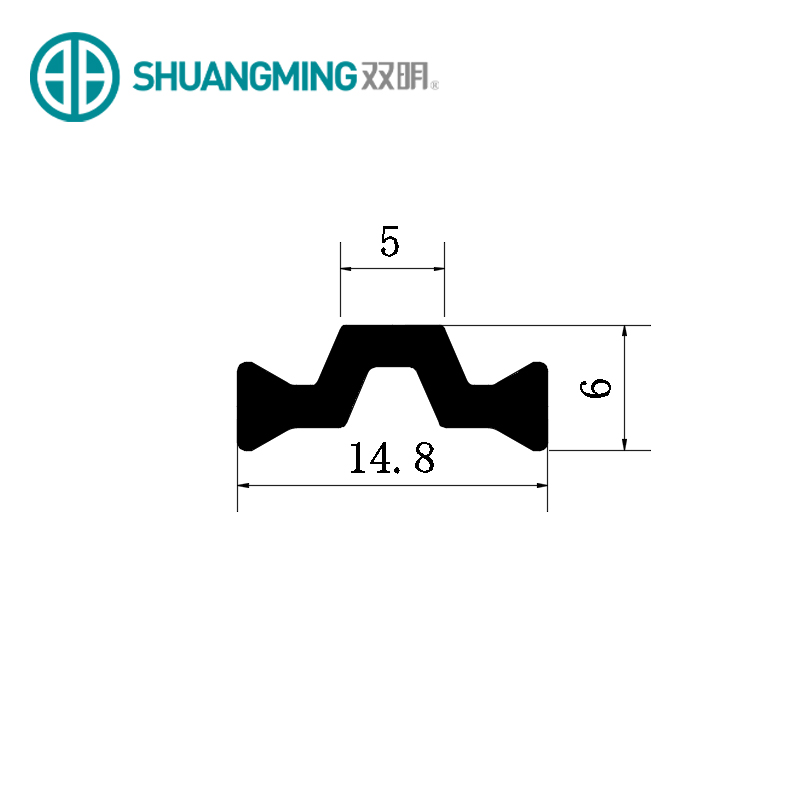
Standard profiles form the backbone of commercial fenestration systems. They offer predictable performance and straightforward manufacturing requirements. We categorize them based on their cross-sectional design.
The I-Type represents the baseline geometry for insulation components. It features a simple, flat, and straight cross-section. This simplicity makes it highly cost-effective to produce. Furthermore, it is incredibly easy to roll and crimp on standard assembly lines. Knurling teeth bite into its flat edges without requiring complex support mechanisms. We recommend I-Type profiles for standard casement windows. They also excel in applications demanding narrow profile depths.
The C-Type profile features a distinctly curved or stepped web. This shape often resembles the Greek letter Omega. The curve enhances water deflection inside the window chamber. Additionally, it creates a longer heat-flow path within the exact same profile width. Heat must travel along the curve rather than in a straight line. This slightly improves the overall thermal performance over basic I-types. C-Type profiles are best for systems requiring better moisture management and moderate U-value improvements.
T-Type profiles incorporate lateral extensions along their length. These extensions serve a crucial dual structural purpose. They provide a secure, integrated channel for central weather stripping. You can slide EPDM or silicone gaskets directly into these grooves. This eliminates the need for extra aluminum mounting points. T-Type profiles are ideal for high-sealing window assemblies. They aggressively prevent air infiltration in demanding environments.
Structural Comparison Chart of Standard Shapes
Profile Shape |
Primary Benefit |
Assembly Difficulty |
Ideal Application |
|---|---|---|---|
I-Type |
Cost-effective, narrow footprint |
Low |
Standard casement windows |
C-Type |
Extended heat path, moisture control |
Low to Medium |
Moisture-resistant frames |
T-Type |
Integrated gasket channels |
Medium |
High-sealing assemblies |
Modern building codes often push standard profiles past their limits. Advanced geometries solve complex thermal and structural problems. These shapes require strict manufacturing tolerances and precise assembly equipment.
Hollow profiles feature closed-cell or multi-chamber internal structures. These internal chambers physically disrupt internal convection currents. Air gets trapped inside the cavities, severely limiting heat transfer. You will find multi-cavity profiles essential for achieving stringent Passive House standards. However, they introduce manufacturing challenges. They require stricter extrusion tolerances to maintain uniform wall thickness. If the walls are too thin, you risk chamber collapse during the crimping process. Assembly teams must carefully calibrate their rolling equipment.
S-Type and IC-Type profiles utilize highly complex, offset geometries. Engineers designed them to handle significant differential thermal expansion. Imagine a dark window frame exposed to intense summer sun. The exterior aluminum half-shell gets incredibly hot and expands rapidly. Meanwhile, the interior half-shell remains cool due to air conditioning. This temperature delta creates massive shear stress across the thermal barrier. S-Type and IC-Type geometries can flex slightly to absorb this stress. They actively address specific structural fatigue problems in high-temperature-differential climates. We deploy them heavily in flush-faced architectural facades. They are also necessary for oversized sliding doors and specialized offset frame designs.
Selecting the correct geometry requires a systematic evaluation. You cannot base decisions on thermal data alone. You must align physical shape with structural loads and factory capabilities. Follow these structured evaluation criteria.
Execute Precise Thermal Mapping: Match the strip width and shape complexity to specific regional Uf-value mandates. For standard climates, a 14.8mm to 24mm solid profile might suffice. For extreme climates, you may need widths exceeding 35mm paired with multi-cavity designs. You must map specific profile features directly to desired thermal outcomes.
Analyze Structural Load & Assembly Mechanics: Assess how specific shapes interact with your factory's knurling depth. Highly complex or asymmetric shapes often require specialized support jigs. During the rolling process, these jigs prevent the profile from twisting or deforming. Ensure your assembly line can physically handle the chosen geometry without crushing it.
Focus on Risk Mitigation: Prioritize dimensional stability above all else. A complex, high-performance shape becomes completely useless if it suffers from post-extrusion shrinkage. Shrinkage compromises the shear strength of the final window frame. Mitigate this risk by vetting your supply chain. Emphasize requiring ISO 9001 and IATF 16949 compliant documentation from your suppliers.
Procurement teams must eventually decide between standard shapes and custom extrusions. Each path carries specific logistical and financial implications.
Standard shapes like I, C, and T types dominate the market for a reason. They carry zero tooling costs. Manufacturers already own the extrusion dies. Furthermore, they offer incredibly short lead times. You can source them rapidly to keep production lines moving. If your frame design allows for standard shapes, they provide the best scalability.
Sometimes, off-the-shelf options simply fail to meet specialized needs. You must build a solid business case for custom dies. Valid reasons for customization include proprietary frame designs. You might need integrated hardware channels extruded directly into the polyamide. Alternatively, your project might demand extreme span requirements that standard shapes cannot support. Customizing polyamide thermal break strips allows for unparalleled design freedom.
Customization requires navigating a specific implementation timeline. First, you face the die design phase. Next comes prototyping and rigorous shear testing. Only after passing these tests can you move to full-scale production. This timeline often takes several weeks or months. Additionally, you must consider minimum order quantity (MOQ) constraints. Custom runs require significant material volume to justify the setup time. You must factor these delays and volume requirements into your project schedule.
Sourcing Pathway Comparison
Factor |
Off-the-Shelf Profiles |
Custom Extruded Profiles |
|---|---|---|
Tooling Cost |
Zero |
High (requires custom steel dies) |
Lead Time |
Short (often stocked) |
Long (requires design and testing) |
Design Flexibility |
Limited to standard catalogs |
Unlimited (within material limits) |
Volume Requirement |
Low minimums |
High minimum order quantities (MOQ) |
Optimizing fenestration systems requires a deep understanding of profile geometry. Material composition provides the baseline, but the physical shape unlocks true performance. By carefully evaluating different geometries, you ensure your frames meet modern energy codes. You also protect the structural integrity of the final installation.
Always follow a strict shortlisting logic. Move systematically from thermal requirements (width and cavities) to structural needs (shape flexibility). Finally, verify assembly capabilities (machinery tolerances).
Do not underestimate the importance of trial assembly. Complex shapes interact differently with knurling and crimping machines.
Require stringent quality documentation to avoid post-extrusion shrinkage issues.
Take action by requesting standard sample kits for trial crimping in your facility.
If standard shapes fall short, share your CAD files with a trusted manufacturer for custom die feasibility analysis.
A: Yes, you can mix different profile shapes within a single assembly. However, it requires careful engineering. You must accurately calculate the neutral axis of the combined profile. Different shapes possess varying stiffness levels. If you fail to balance them, the frame may warp significantly under severe thermal stress or heavy wind loads.
A: Standard commercial ranges typically go up to 50mm. However, extreme widths are available for specialized applications. Manufacturers can extrude profiles up to 195mm specifically for demanding Passivhaus designs. These ultra-wide strips require multi-cavity designs to maintain essential structural rigidity and prevent twisting.
A: Yes, the profile shape directly impacts assembly processes. Simple flat shapes easily accept standard crimping rollers. Conversely, hollow and highly asymmetric shapes, like IC-types, require specific roller configurations. You must use specialized support jigs to ensure the aluminum bites securely into the polyamide without crushing the internal chambers.


