
Views: 0 Author: Site Editor Publish Time: 2026-04-06 Origin: Site


Thermal break polyamide strips are engineered insulating components inserted between the interior and exterior aluminum sections of a framing system. In curtain walls, they create a barrier that interrupts the direct metal-to-metal path through the profile, which helps reduce heat transfer while still allowing the framing system to maintain structural performance. EN 14024 specifically applies to thermal barrier profiles used mainly for windows, doors, screens, and curtain walls, and it focuses on mechanical performance assessment for systems where the thermal barrier contributes to the profile’s resistance.
In industry use, polyamide thermal break often refers to the overall insulating function inside a thermally improved aluminum system, while polyamide thermal break strip refers more specifically to the physical strip inserted between aluminum sections. In façade applications, these strips are commonly made from glass-fiber-reinforced polyamide because the material offers a practical balance of insulation performance, strength, and dimensional stability.
Curtain walls rely heavily on aluminum because it is lightweight, durable, and well suited to large glazed façades. The challenge is that aluminum transfers heat very easily. Without a thermal break, heat can move through the framing much faster, reducing the façade’s energy efficiency and increasing the risk of condensation on interior-facing surfaces.
For this reason, thermal break systems are now a core part of high-performance curtain wall design. They help aluminum façades meet modern expectations for energy efficiency, occupant comfort, and condensation control while preserving the visual and structural benefits of metal framing.
In curtain walls, the strip is not only an insulating element. It also needs to remain stable inside the aluminum profile and support the long-term reliability of the system. That is why curtain wall thermal break strips must combine good insulation with dependable mechanical performance.
Heat naturally moves through aluminum very quickly. When a polyamide strip is inserted between the two aluminum sections, the flow of heat is reduced because the strip material is far less conductive than metal. The result is improved thermal separation between indoor and outdoor environments, which supports better façade insulation performance.
By limiting thermal bridging, the interior aluminum surface is less likely to become cold enough for indoor moisture to condense on it. In practical building terms, this can help reduce water droplets, discomfort near the façade, and moisture-related issues associated with poorly insulated framing systems. This is one reason thermal break design is so important in cold climates and in buildings with large glazed areas.
In curtain walls, the strip is not just an insulator. EN 14024 addresses systems in which the thermal barrier contributes to the mechanical resistance of the profile, which shows that the barrier must also be evaluated for structural behavior, not only for thermal separation.
Polyamide is widely used because it offers a practical balance of insulation, strength, processability, and long-term dimensional stability. In curtain wall applications, the thermal break material must survive fabrication, service loads, environmental exposure, and temperature changes while continuing to hold the system together accurately.
PA66 is one of the most common base materials used for thermal break strips because it offers a strong combination of strength, rigidity, heat resistance, and long-term stability. When reinforced with glass fiber, it becomes even more suitable for demanding curtain wall applications where both dimensional accuracy and structural reliability matter.
Glass fiber reinforcement strengthens the polyamide and improves dimensional stability under load and temperature variation. Those properties are especially important in curtain wall framing, where the strip must remain reliable over long service periods and under changing environmental conditions.
In curtain wall systems, polyamide thermal break strips are typically positioned between the inner and outer aluminum sections of framing members such as mullions and transoms. Their role is to create a clear insulating separation that reduces direct heat transfer from the exterior side of the façade to the interior side.
Mullions are the vertical framing members of a curtain wall. Thermal break strips in mullions help reduce vertical heat transfer paths and improve the thermal behavior of the façade grid.
Transoms are the horizontal framing members. Using thermal break strips in transoms helps maintain consistent thermal separation throughout the system rather than only in selected areas.
Because curtain walls are large, repetitive assemblies, the performance of each thermal break strip can influence the behavior of the entire façade. Proper strip placement, profile compatibility, and system design all affect the final thermal result.
Polyamide thermal break strips can be used in a wide range of curtain wall systems, including stick-built systems, unitized systems, and other thermally improved façade assemblies. The exact strip geometry and connection method may vary depending on the profile design, but the purpose remains the same: to separate the interior and exterior aluminum sections while supporting overall system performance.
Most high-performance thermal break strips for curtain walls are made from polyamide 66 reinforced with glass fiber. This material combination is widely used because it can provide both effective thermal separation and the mechanical properties needed in demanding aluminum framing systems.
Material formulation has a direct impact on strength, rigidity, process consistency, and long-term durability. In curtain wall applications, this matters because the thermal break strip is part of a larger framing system and must continue performing reliably over time.
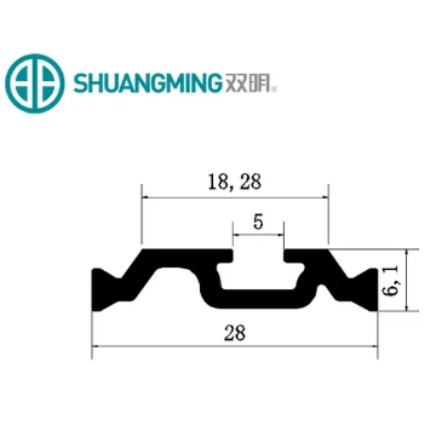
Polyamide thermal break strips are usually produced through extrusion. The polyamide compound is prepared, melted, shaped through a die, cooled, and then cut or wound into a form suitable for fabrication and shipment. Manufacturing precision is especially important because curtain wall systems rely on tight dimensional control for assembly quality and long-term performance.
The process begins with preparing the polyamide formulation, often including glass fiber reinforcement. Consistent compounding helps stabilize the strip’s final mechanical and dimensional properties.
The material is extruded into the required geometry. Strip shape matters because it must match the aluminum profile design and the intended assembly method.
Some manufacturers also use additional process options to improve surface quality, traceability, or downstream fabrication performance. These details can be important in projects where consistency and processing reliability are a priority.
Mechanical strength is one of the most important properties in curtain wall applications because the strip must remain reliable inside a composite aluminum profile. In practical terms, the strip needs to support the system’s long-term stability rather than act as a simple insulating filler.
EN 14024 is centered on the mechanical performance of metal profiles with thermal barriers, including proof and tests for assessment. IFT Rosenheim also highlights shear strength and elasticity constant testing under DIN EN 14024, showing how connection behavior is evaluated in practice.
Dimensional stability is essential for precise assembly and long-term compatibility with aluminum profiles. Reinforced PA66 is used partly because of its higher rigidity and stability compared with unreinforced material.
Long-term durability is equally important because curtain wall thermal break strips may be exposed to humidity, temperature changes, and continuous environmental stress over many years. A reliable material should maintain stable performance under real service conditions, not just in ideal factory conditions.
Thermal break strips should also be evaluated by how much they improve the performance of the full curtain wall system. Their value is not limited to the strip itself, but to how effectively they help the overall façade reduce heat transfer and improve energy efficiency.
Polyamide is often preferred in high-performance curtain wall systems because it supports both thermal insulation and structural reliability. Compared with less robust alternatives, glass-fiber-reinforced polyamide offers a stronger balance of strength, stiffness, dimensional stability, and long-term performance.
From a system perspective, their value comes from combining low-conductance separation with structural usefulness. That combination is one reason polyamide thermal break strips are widely used in premium aluminum façade systems instead of simpler insulating inserts that do not contribute meaningfully to profile resistance.
Polyamide is often preferred in composite thermal barrier framing systems because it supports both structural and thermal goals. AAMA TIR-A8 specifically addresses material selection, cavity design, and structural and thermal performance testing, which suggests that choosing a barrier material is about total system behavior, not just nominal insulation value.
Compared with less structurally capable alternatives, glass-fiber-reinforced PA66 is attractive because of its strength, stiffness, creep resistance, and dimensional stability. In curtain walls, where the barrier is integrated into the framing system and expected to perform over long service periods, those properties are especially valuable.
When evaluating thermal break strips for curtain wall applications, buyers should pay attention to mechanical strength, dimensional stability, long-term durability, and how well the strip matches the intended aluminum profile system. Products that perform well in real fabrication and long-term service are usually more valuable than materials that only look strong on paper.
Buyers should evaluate the strip as part of the entire curtain wall system rather than as a standalone plastic component. The right choice depends on the profile design, climate demands, structural requirements, fabrication method, and the supplier’s quality control capability.
A supplier should clearly identify the polyamide grade and reinforcement system used. Reinforced PA66 is widely valued for higher strength and dimensional stability.
Buyers should review whether the product has been tested in a way that reflects real curtain wall performance. It is more useful to focus on practical data such as strength, dimensional consistency, durability, and system compatibility than to rely only on general material claims.
Manufacturing quality is just as important as material choice. Precision extrusion, surface consistency, traceability, and stable production control all influence the final performance of the strip in actual curtain wall fabrication.
The strip geometry must match the curtain wall profile and assembly method. In practice, this means buyers should look beyond generic material claims and confirm actual compatibility with the intended mullion, transom, and façade design.
These risks are important because thermal break strips affect not only insulation performance, but also fabrication quality, profile stability, and the long-term durability of the full curtain wall system.
Thermal break polyamide strips are critical components in modern curtain wall design. They separate the interior and exterior aluminum sections of the façade, reduce thermal bridging, help control condensation, and improve the overall thermal performance of the system. At the same time, they must remain mechanically reliable so the curtain wall can maintain stable long-term performance.


