
Views: 0 Author: Site Editor Publish Time: 2026-04-08 Origin: Site


Choosing the right material for a thermal break strip is one of the most important decisions in aluminum system design. In windows, doors, and curtain walls, the strip is the key non-metallic component that separates the interior and exterior aluminum sections. Its purpose is not only to reduce heat transfer, but also to help the profile maintain stability and long-term performance.
That is why polyamide selection should never be treated as a minor material choice. A good thermal break strip must combine insulation, strength, dimensional stability, and durability. If the material is not suitable, the final aluminum system may face problems in production, assembly, and long-term use.
Polyamide has become one of the most widely used materials for thermal break strips because it offers a very practical combination of performance advantages. It provides low thermal conductivity compared with aluminum, while also delivering the mechanical properties needed for demanding building systems.
Another reason polyamide is so widely accepted is its processability. It can be extruded into precise strip geometries, making it well suited for aluminum systems that require accurate dimensions and consistent performance. For manufacturers, this makes polyamide a reliable solution for both standard and custom profile designs.
In practical terms, the question today is often not whether polyamide should be used, but which type of polyamide is the best match for the intended application.
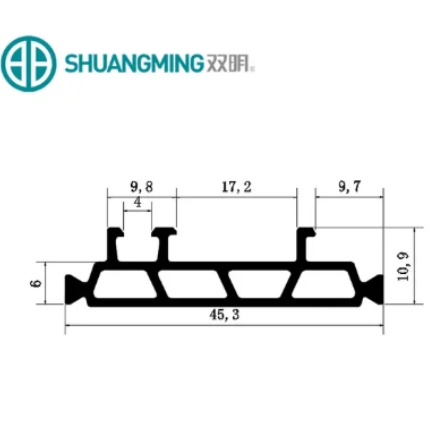
Among the available polyamide grades, PA66 is one of the most common choices for thermal break strip production. It is widely preferred because it offers a strong balance of heat resistance, strength, rigidity, and processing stability.
For many aluminum systems, PA66 provides the reliability needed in daily production as well as long-term service. It performs well in applications where the strip must maintain shape, fit tightly with the aluminum profile, and remain stable over time under changing environmental conditions.
This is why PA66 is often seen as the mainstream material choice for quality thermal break strips.
In most structural thermal break applications, unreinforced polyamide is not enough. Glass fiber reinforcement is usually added to improve strength, rigidity, and dimensional stability.
This matters because a thermal break strip is not simply acting as an insulating insert. It is part of a working aluminum profile system. During fabrication and service, the strip may experience load, pressure, temperature changes, and repeated stress. Reinforcement helps the material resist deformation and maintain consistent performance.
For buyers, this means glass fiber content is not just a technical detail. It is one of the most important factors affecting the final quality of the strip.
PA66 GF25 is widely used in the thermal break strip market because it offers a practical balance between mechanical strength and thermal performance. It is strong enough for many demanding applications, while still supporting good insulation performance in finished aluminum systems.
For many manufacturers, PA66 GF25 is attractive because it works well across a broad range of windows, doors, and curtain wall profiles. It provides stable extrusion behavior, good structural support, and reliable dimensional control, which makes it suitable for both standard production and customized solutions.
Although other reinforced formulas are also used in the market, PA66 GF25 remains one of the most common and trusted options.
Selecting the right polyamide should never be based on price alone. A good decision depends on understanding the full set of material properties that affect the strip’s performance.
The first task of a thermal break strip is to reduce heat transfer through the aluminum profile. The chosen material should support the thermal goals of the final system and help improve the energy efficiency of windows, doors, or curtain walls.
A thermal break strip must also provide enough strength to remain stable during fabrication and use. If the material is too weak, the profile may lose structural reliability or develop performance issues over time.
Stable dimensions are essential in thermal break strip production. If the material expands too much, shrinks excessively, or becomes unstable under changing conditions, it can affect assembly accuracy and long-term compatibility with aluminum profiles.
Because thermal break strips are often under load for long periods, long-term deformation resistance is very important. A material that performs well in short-term testing may still create problems if it gradually deforms in service.
The strip must remain reliable over time despite exposure to temperature changes, humidity, and daily environmental stress. Long-term durability is especially important in systems expected to perform for many years without failure.
Moisture is one of the most important factors in polyamide selection. Polyamide materials naturally absorb moisture, and this can influence both their dimensions and mechanical behavior.
For thermal break strips, moisture affects performance in several ways. It can change dimensional stability, alter strength characteristics, and influence how the material behaves during processing. This means buyers should not only ask how a material performs in ideal conditions, but also how it behaves after exposure to humidity and real service environments.
A material with strong headline properties may still be the wrong choice if it becomes unstable when moisture conditions change. That is why moisture behavior should always be considered during material evaluation.
The right polyamide depends heavily on where and how the strip will be used. There is no single formula that is ideal for every aluminum system.
Window systems usually require a balance between thermal insulation, dimensional precision, and moderate structural strength. In many cases, standard reinforced PA66 grades are suitable when consistent quality and accurate extrusion are well controlled.
Door systems often place more emphasis on toughness, long-term dimensional stability, and resistance to repeated use. Because doors may face more mechanical stress during daily operation, material selection should pay closer attention to rigidity and creep resistance.
Curtain wall systems often place higher demands on thermal break strips because they are used in larger and more demanding structural assemblies. In these applications, the strip must combine good insulation with excellent dimensional stability and reliable long-term performance.
Projects in severe climates or high-performance building envelopes may require more specialized formulations. In these cases, standard materials may still work, but tailored solutions may offer better results in thermal efficiency, impact resistance, or environmental durability.
Even the right material type can perform poorly if raw material quality is inconsistent. That is why buyers should pay attention not only to the formula name, but also to the supplier’s control over compounding, glass fiber content, and batch consistency.
A good thermal break strip depends on stable raw materials. If formulation quality varies from batch to batch, the strip may show inconsistent dimensions, uneven strength, or unstable production behavior. This can cause problems in extrusion, profile assembly, and final product quality.
In other words, material quality is not only about the polymer itself. It is also about how reliably that material is produced.
In many projects, a standard reinforced PA66 grade is enough. If the application is conventional and the aluminum profile design is already well established, a standard material can provide a good balance of cost, performance, and production efficiency.
However, customized formulations may be a better choice when the application has special requirements. This may include higher structural loads, more demanding climate conditions, stricter thermal targets, or unusual profile geometries.
Customized options can be useful when buyers need better insulation, improved impact resistance, or a material that is optimized for a specific production process. The right choice depends on whether a standard grade can fully meet the actual needs of the project.
Choosing the wrong polyamide can create problems that are expensive to fix later. These problems may appear during production, during profile assembly, or after the finished system is already in use.
Common risks include poor dimensional stability, weak mechanical strength, excessive deformation under load, cracking, brittleness, or reduced thermal performance in the final aluminum system. In some cases, the material may seem acceptable at first, but performance problems only appear over time.
This is why polyamide selection deserves serious attention from the start. The wrong material can affect not only the strip itself, but the reliability of the entire aluminum profile system.
The supplier matters almost as much as the material choice. A strong supplier should be able to explain its material system clearly, provide stable product quality, and support the customer with technical knowledge when needed.
When evaluating a supplier, buyers should look for:
clear material specifications
stable raw material quality
reliable production consistency
good dimensional control
technical support for different applications
the ability to provide customized solutions when needed
dependable delivery and long-term supply stability
A supplier that understands both material performance and strip production is usually in a much better position to support real project requirements.
The best polyamide for a thermal break strip is not always the strongest one, the cheapest one, or the most commonly used one. The best choice is the one that matches the actual performance needs of the final aluminum system.
A smart decision should consider the application, thermal target, structural demands, environmental conditions, processing requirements, and supplier capability together. When all of these factors are evaluated as a whole, the material choice becomes much more reliable.
In most cases, reinforced PA66 remains one of the best options because it offers a strong balance of insulation, strength, stability, and production suitability. But the final decision should always be based on the real needs of the project rather than on a generic assumption.
Choosing the right polyamide for your thermal break strip means looking beyond basic material names. A good strip must support insulation performance, mechanical reliability, dimensional stability, and long-term durability in real aluminum systems.
For many applications, reinforced PA66 is a leading choice because it performs well across a wide range of windows, doors, and curtain wall systems. But the most important point is not simply choosing a known material. It is choosing a material that truly fits the application, the production process, and the long-term performance goals of the project.
When the right polyamide is matched with strong raw material quality and a capable supplier, the result is a thermal break strip that performs reliably from production to final installation.


