
Views: 0 Author: Site Editor Publish Time: 2026-04-15 Origin: Site


When choosing a thermal barrier for aluminum windows, doors, or curtain walls, the material inside the profile matters more than many buyers expect. A well-designed barrier can improve insulation, reduce condensation, and support long-term profile stability. In the market, polyamide thermal break systems are commonly compared with older resin-based solutions, especially poured resin or polyurethane-style barriers. Public industry materials describe these as two common ways to create a thermal break in aluminum systems: preformed polyamide strips or poured resin-based barriers.
If your goal is to understand why more manufacturers and project teams now prefer polyamide thermal break strip solutions, the answer usually comes down to a better balance of insulation, structural reliability, design flexibility, and production consistency. That is why polyamide has become the preferred choice in many modern aluminum systems.
The first major difference is the way the thermal barrier is formed inside the aluminum profile. A polyamide thermal break uses a preformed insulating strip that is inserted and rolled between two aluminum sections. A resin thermal break is usually created by pouring a liquid resin-based material into a cavity and then forming the thermal barrier in place. Because the production logic is different, the final performance is shaped not only by the material itself, but also by how precisely that barrier is made and integrated into the profile.
This difference is one reason polyamide is often seen as the more advanced option in modern systems. The strip arrives as an engineered component with a defined geometry, which allows more control over width, shape, and consistency. Resin systems can still work well in certain applications, but they are more dependent on the cavity design and pouring process during fabrication.
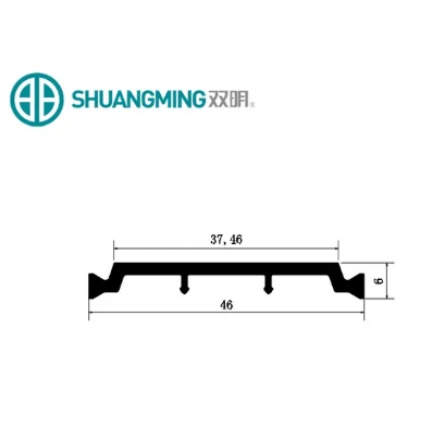
One of the most frequently mentioned advantages of polyamide is improved thermal efficiency. Industry sources comparing the two approaches note that polyamide systems can support larger thermal barriers than older narrow resin breaks, which can help improve overall window and frame thermal performance. One comparison page specifically claims at least a 30 percent improvement in typical window Uw figures when moving from older resin barriers to polyamide. That number should be treated as supplier-specific rather than universal, but it reflects a common market view that polyamide often performs better in newer thermally optimized designs.
The practical reason is straightforward: wider and more precisely engineered polyamide strips give designers more room to improve thermal separation between the inside and outside aluminum sections. In many systems, that added design freedom helps lower heat transfer more effectively than older resin-based barriers.
A thermal break is not only there to slow heat flow. It also has to remain reliable inside a working aluminum profile. This is where polyamide often has an advantage. Suppliers and technical manufacturers consistently position polyamide strips as structural insulating profiles rather than simple fillers. They are used in systems where long-term shape retention, profile stability, and accurate joining matter.
Glass-fiber-reinforced polyamide grades are especially valued because they combine insulation with strength and dimensional stability. This makes them suitable for applications such as high-performance windows, doors, and curtain walls where the barrier must continue performing under temperature changes, service loads, and long-term use.
By contrast, resin thermal barriers are often described more in terms of the poured process than in terms of a precise structural profile. That does not make resin ineffective, but it does help explain why polyamide is often preferred when both structural performance and thermal efficiency are priorities.
Another important advantage of polyamide thermal break strip systems is design flexibility. Because the strips are extruded into specific shapes and sizes, they can be matched more precisely to different aluminum profile systems. Technoform and other industry suppliers emphasize the availability of both standard geometries and tailored profiles for windows, doors, facades, and other aluminum components.
This flexibility is valuable for manufacturers developing premium systems, narrow sightline profiles, high-insulation products, or custom facade solutions. A wider choice of strip geometries gives more freedom in balancing insulation, strength, fabrication needs, and profile design. Resin systems can be practical in certain standardized cavity designs, but they generally do not offer the same product-style geometry flexibility as preformed polyamide strips.
Consistency is one of the biggest reasons many manufacturers favor polyamide over resin-based barriers. A polyamide strip is made as a finished component before it enters the thermal break assembly process. That means the strip dimensions, shape, and material formulation can be controlled before assembly. In a resin system, the barrier is created during production, so the result depends more heavily on pouring conditions, curing, cavity preparation, and process control at that moment.
For fabricators, better consistency can mean fewer variations in assembly quality and more predictable final performance. This is especially important in larger production environments where repeatability matters for every batch of profiles.
Polyamide thermal break systems are widely used in applications where higher performance is expected. Supplier and market materials consistently associate polyamide strips with aluminum windows, doors, facades, and curtain walls designed for stronger insulation and better long-term reliability.
This is especially important in curtain walls and large glazed assemblies, where the thermal barrier has to do more than just reduce heat transfer. It also has to support the overall performance of a more demanding framing system. In these applications, the combination of engineered strip geometry, reinforced material options, and stable assembly makes polyamide especially attractive.
A better thermal barrier does more than improve energy numbers on paper. It can also reduce the chance of condensation on the interior-facing aluminum surfaces. When less heat is conducted through the frame, indoor-side temperatures stay more stable, which can help reduce moisture buildup and improve comfort near windows and facades. Thermal break suppliers commonly promote polyamide systems around these benefits, especially in energy-efficient building envelopes.
For building owners and project developers, this means polyamide thermal break solutions can contribute not only to efficiency, but also to better real-world performance in occupied spaces.
Another practical advantage is that polyamide systems are easier to standardize across different profile families. Since the strip is a defined product, manufacturers can use a broad range of strip sizes and geometries across multiple series of windows, doors, and facade systems. This makes it easier to develop scalable product platforms while still tuning thermal performance for each design.
Resin thermal break solutions may still be useful in certain older or process-specific setups, but polyamide often gives manufacturers more freedom to build a broader, more modern product range around one thermal break technology.
The market trend is clear from supplier positioning: polyamide is increasingly presented as the preferred solution for future-facing aluminum systems, while resin-based barriers are often described as older technology or an alternative associated with earlier systems. Even sources that present both methods side by side typically frame polyamide strips as a modern structural insulating system with broader application potential.
That shift does not mean resin thermal breaks have disappeared. It means many manufacturers now see polyamide as the better answer for products that need stronger insulation, wider design possibilities, and more dependable long-term system performance.
The main advantages of polyamide thermal break over resin thermal break come down to four things: better thermal potential in many modern designs, stronger structural support, greater design flexibility, and more consistent manufacturing control. For buyers and manufacturers who want a higher-performance aluminum system, those advantages make polyamide a very compelling choice.
That is why polyamide thermal break strip solutions are now widely used in advanced windows, doors, curtain walls, and facade systems. They are not just insulating inserts. They are engineered components that help aluminum systems become more efficient, more stable, and more competitive in modern construction.


