
Views: 0 Author: Site Editor Publish Time: 2026-03-06 Origin: Site


When buyers ask us what the best material is for a thermal isolation strip, they are usually trying to solve a very practical product question: which material gives the right balance of thermal performance, structural reliability, processing stability, and long-term consistency in aluminum window, door, or curtain wall systems. A thermal break strip is not just an “insulating insert.” It is a functional component that must separate inner and outer aluminum profiles while still carrying mechanical loads and holding dimensional stability in daily use.
From our perspective as a thermal break strip supplier, the best material is usually the one that does two jobs well at the same time. First, it must reduce heat transfer between the aluminum sections. Second, it must remain stable enough to support the mechanical demands of the profile system. In most mainstream aluminum window and facade applications, glass-fiber-reinforced polyamide 66, especially PA 66 GF25, is widely used because it combines strong mechanical stability, heat resistance, and suitability for thermal barrier applications with mechanical functions. Technoform, for example, states that PA 66 GF25 is suitable for use as a thermal barrier with mechanical functions according to EN 14024, and describes its glass-fiber-reinforced PA 6.6 as offering high mechanical stability and heat resistance.
A thermal isolation strip sits between two aluminum sections and reduces heat transfer across the profile. At the same time, it is part of the profile’s structural connection, so it must handle more than insulation alone.
A good thermal break strip should offer:
low thermal conductivity
strong mechanical stability
reliable dimensional consistency
heat resistance during production and service
compatibility with rolling or profile assembly processes
long-term performance under humidity and temperature changes
This is why the “best” material is not simply the one with the lowest thermal conductivity on paper. It also has to perform reliably as a structural connector in real manufacturing and real buildings.
In most standard aluminum window, door, and facade systems, PA 66 GF25 is commonly seen as the best all-around material because it offers a strong balance between insulation and mechanical support. This is partly an industry inference based on how widely it is used for structural thermal barrier strips and the type of performance manufacturers publish for it. Technoform specifically notes that its glass-fiber reinforced PA 6.6 GF25 is optimized for demanding environments, offers high mechanical stability, and is suitable as a thermal barrier with mechanical functions according to EN 14024.
A thermal break strip must not only “insulate.” It also has to hold shape and support the joined aluminum profiles. Technoform describes glass-fiber-reinforced PA 6.6 as offering high stiffness and high mechanical stability, which is one of the main reasons this material is used for structural and reinforcement profiles.
The material needs to perform in hot production environments and in buildings exposed to sunlight and seasonal temperature changes. Technoform notes that these polyamides offer strong heat resistance and can be used in hot and humid conditions.
PA 66 GF25 is not a niche material. It is widely used in insulation profiles for windows, doors, and facades, which makes it a trusted option for mainstream systems. Technoform’s documentation repeatedly identifies PA 66 GF25 strips as suitable for these applications.
Technoform states that PA 66 GF25 is suitable to be used as a thermal barrier with mechanical functions according to EN 14024, which is highly relevant for strip-based thermal break systems.
For these reasons, when customers ask us for the “best” material in a practical, mass-production sense, PA 66 GF25 is usually the first recommendation for many standard profile systems.
If the goal is to push thermal performance further, some buyers look at low-lambda polyamide options. Technoform offers low-lambda PA 66 materials and notes that these are also based on glass-fiber-reinforced PA 66 and are intended to maintain structural requirements while improving frame thermal values.
projects with stricter thermal targets
slimline profile systems where every performance gain matters
systems that want to improve frame U-value results while keeping a familiar polyamide base
Low-lambda materials can be excellent, but not every project needs that additional optimization. For many mainstream systems, standard PA 66 GF25 already provides a strong balance of performance, manufacturability, and cost.
So if your target is “best thermal performance within the same general material family,” low-lambda PA 66 may be worth considering. If your target is “best overall balance for everyday use,” standard PA 66 GF25 often remains the practical choice.
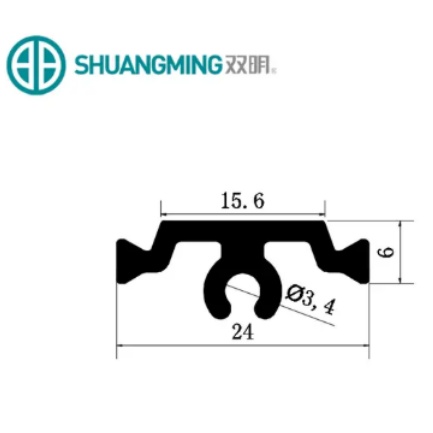
Some systems also use PA 66 GF40, which increases glass fiber content. Technoform lists PA 66 GF40 among its insulating strip materials and shows it as another structural polyamide option.
Higher glass content may improve stiffness, but that does not automatically make it the best material for every strip geometry or every assembly process. In many conventional systems, GF25 remains the more common benchmark because it balances strength with processability and established profile performance.
Yes. There are other engineered materials used in the market for special profile designs. Technoform’s broader material documentation includes examples such as PBT GF30 and bio-based polyamide variants for certain insulation profiles.
However, these are usually more application-specific rather than the standard answer for most aluminum thermal break strips. In mainstream industrial practice, PA 66 GF25 remains the most recognized reference material for strip-based thermal break systems because it is widely proven, structurally capable, and well matched to the requirements of aluminum windows and facades. This conclusion is an industry-style inference based on the breadth of PA66 GF25 usage and certification-oriented documentation shown in the cited product data.
Material Option |
Main Strength |
Best For |
Practical Note |
PA 66 GF25 |
Strong balance of insulation and mechanical stability |
Standard windows, doors, facades |
Most widely trusted all-around choice |
Low-Lambda PA 66 |
Improved thermal performance within PA66 family |
Higher-performance frame targets |
Useful when thermal values are pushed further |
PA 66 GF40 |
Higher stiffness potential |
More demanding structural profiles |
More specialized than GF25 |
Other engineered materials |
Application-specific benefits |
Special profile designs |
Usually selected for niche requirements |
Even if PA 66 GF25 is often the best general answer, material selection still needs to match the actual system.
If the strip is expected to perform as a mechanical connector, material suitability for structural thermal barriers matters. Technoform explicitly notes such suitability for PA 66 GF25 under EN 14024-related functions.
If the project is trying to reach higher frame-level thermal performance, low-lambda variants may be worth reviewing.
The strip must fit your rolling, assembly, and profile design process—not just look good on a datasheet.
Heat, humidity, and long-term use conditions should be considered. PA-based materials are often chosen because of their heat resistance and mechanical durability in such environments.
So, what is the best material for thermal break strips? In most mainstream aluminum window, door, and facade applications, glass-fiber-reinforced PA 66, especially PA 66 GF25, is usually the best all-around choice because it combines strong mechanical stability, good heat resistance, and established suitability for thermal barrier applications with mechanical functions. Technoform’s published material information supports this by identifying PA 66 GF25 as a structural thermal barrier material suitable under EN 14024-related functions and by highlighting its high mechanical stability and heat resistance.
That said, the best choice still depends on your profile system, your thermal target, and your manufacturing needs. For projects aiming at even stronger thermal performance, low-lambda PA 66 options may be worth considering, while more specialized designs may use other engineered materials. If you are evaluating thermal isolation strip options for your aluminum systems and want a practical recommendation based on your product requirements, you are welcome to learn more through www.shuangming-plastic.com. We are glad to share product details and help you choose a suitable strip solution for your application.
A very common material is glass-fiber-reinforced PA 66, especially PA 66 GF25, because it is widely used for thermal barrier profiles with mechanical functions.
It is popular because manufacturers describe it as offering high mechanical stability, heat resistance, and suitability for structural thermal barrier use.
It can be better when the project needs improved thermal performance, but standard PA 66 GF25 is still often the most practical all-around choice for mainstream systems.
Yes. In many aluminum profile systems, the strip acts as both a thermal barrier and a mechanical connector, so structural performance matters in addition to insulation.

