
Views: 0 Author: Site Editor Publish Time: 2026-03-10 Origin: Site


When customers ask us how thick a thermal isolation strip should be, they are usually trying to answer a much bigger question: how to balance thermal performance, structural strength, profile design, and manufacturing practicality in one system. In aluminum windows, doors, and curtain walls, the thermal break is not just a small plastic insert between two metal sections. It is a key design element that affects insulation performance, profile stability, assembly compatibility, and the overall behavior of the finished frame. That is why “thicker” is not automatically “better,” and “standard” does not mean the same thing for every project.
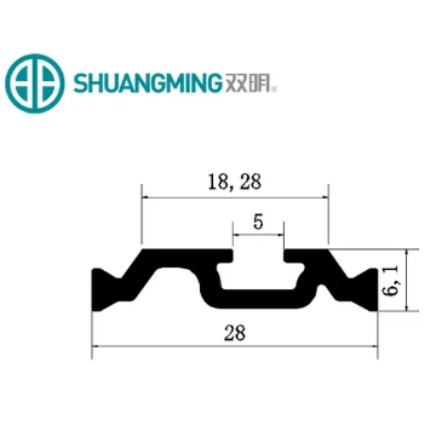
From our perspective, the right thickness depends on the application, the aluminum profile system, the target thermal performance, and the project’s structural needs. In the market, common polyamide thermal break strip widths for windows, doors, and curtain walls are often seen in ranges such as 12 mm, 14.8 mm, 18 mm, 18.6 mm, 20 mm, 22 mm, 24 mm, 25 mm, 30 mm, 32 mm, 34 mm, and 35 mm, with wider or more specialized profiles used in some higher-performance systems. Some system catalogs also show even broader standard profile families extending from around 9 mm up to 77 mm, depending on geometry and application.
At www.shuangming-plastic.com, we understand that customers are not only asking for a size—they are asking for the right thermal break solution for real production and real building performance. In this article, we will explain how thermal break thickness is usually selected, what common thickness ranges mean, and what factors matter most when choosing the correct thermal isolation strip for your system.
A thermal break is the insulating section placed between the inner and outer aluminum profiles in thermally broken window, door, or façade systems. Its main purpose is to reduce direct heat transfer through the aluminum frame and create separation between the two metal sections.
In practical use, the thermal isolation strip helps with:
reducing thermal conductivity through the frame
improving overall frame insulation performance
helping limit temperature transfer between inside and outside surfaces
supporting frame system design in energy-conscious construction
In many aluminum systems, the thermal break strip is made from PA66 GF25 polyamide, a reinforced material commonly used for this purpose. Multiple product references describe thermal break strips as polyamide profiles with glass fiber reinforcement, often in the PA66 GF25 category.
The most honest answer to “How thick should a thermal break be?” is this: the correct thickness depends on the system design.
For many aluminum doors and windows, common thermal break strip widths are frequently in the range of 14.8 mm to 24 mm, while more demanding systems may use 25 mm, 30 mm, 32 mm, 34 mm, 35 mm, or even larger specialized profiles.
12 mm to 14.8 mm: often used in lighter or more basic systems
18 mm to 24 mm: very common in mainstream window and door systems
25 mm to 35 mm: often seen in higher-performance or more demanding profile systems
Above 35 mm: typically used in more specialized or advanced façade / high-insulation designs
This does not mean one range is always superior. It means the strip thickness should match the thermal target and the aluminum profile structure.
Thermal break thickness directly affects how much separation there is between the inner and outer aluminum sections. In simple terms, a wider thermal break generally increases the insulating path between the two metal sides.
More separation can help improve thermal barrier performance
It can support better frame system insulation targets
It may influence condensation control behavior in the overall frame design
It changes the geometry and structural relationship of the profile system
However, thickness is only one part of the result. Material quality, profile geometry, assembly method, and the rest of the frame design also matter.
In real product catalogs and standard profile programs, the following widths commonly appear for aluminum systems:
Common Width Range | Typical Use Direction |
12 mm | Compact or lighter systems |
14.8 mm | Common classic window systems |
18 mm / 18.6 mm | Standard window and door applications |
20 mm / 22 mm / 24 mm | Mainstream insulated window and door systems |
25 mm to 35 mm | Higher-performance windows, doors, and some curtain wall systems |
Above 35 mm | More advanced or project-specific systems |
These width ranges are widely reflected in supplier and profile references for thermal break bars and insulating profiles.
Some standard profile programs also show that the overall available range can extend much further, depending on profile geometry and project type.
A common misconception is that the thickest thermal isolation strip is always the right choice. In practice, that is not always true.
A thicker thermal break may help increase separation, but it can also affect:
aluminum profile design
assembly complexity
tooling and rolling process compatibility
structural behavior of the frame
overall cost and manufacturing efficiency
That means the ideal thickness is the one that gives the system the required thermal and mechanical balance, not simply the widest strip available.
The first decision point is the product type. A residential window frame, a commercial door system, and a curtain wall profile do not have the same design needs.
Windows often use very common widths such as 14.8 mm, 18.6 mm, 20 mm, 22 mm, and 24 mm.
Doors may use similar or slightly adjusted sizes depending on profile depth and structural demands.
Curtain walls may use wider or more specialized insulating profiles depending on project performance targets.
If the project requires a higher-performing frame system, the thermal break thickness may need to increase as part of the overall design strategy. But this is usually decided together with profile depth, glazing system, seals, and overall thermal target—not in isolation.
The thermal break strip must work with the aluminum sections mechanically. If the strip is too narrow, it may limit performance goals. If it is too wide for the system, it can complicate profile design or assembly.
The strip must be compatible with the grooving, rolling, and assembly process used by the profile manufacturer. Even if the width looks correct on paper, production efficiency and consistency still matter.
Many manufacturers work within standard profile families, so common widths such as 14.8 mm, 18.6 mm, 20 mm, and 24 mm are often preferred because they fit existing tooling and mainstream system designs.
For many common aluminum window systems, thermal break widths in the 14.8 mm to 24 mm range are frequently used. These widths are common because they provide a practical balance of insulation, manufacturability, and profile compatibility.
Door systems often use similar widths, but the correct choice depends on profile depth and the required structural behavior. In some systems, widths in the 18 mm to 24 mm or higher range are common.
Curtain walls may use more specialized and often wider insulating profiles, especially in performance-oriented façade systems. Some references show extensive standard profile families and larger curtain wall spacer formats.
So, how thick should a thermal break be? In practical terms, the answer depends on the application, the aluminum profile system, the target thermal level, and the assembly process. In the market, common thermal isolation strip widths often include 12 mm, 14.8 mm, 18 mm, 18.6 mm, 20 mm, 22 mm, 24 mm, and larger options such as 25 mm to 35 mm, with broader standard families extending further for specialized systems. The right thickness is not simply the largest one—it is the one that gives the system the right balance of insulation, structural compatibility, and manufacturing practicality.
At www.shuangming-plastic.com, we believe the best thermal break solution should fit the real product, not just a number on a drawing. If you are evaluating a thermal isolation strip for windows, doors, or curtain wall systems, you are welcome to learn more through www.shuangming-plastic.com and explore the most suitable option for your project.
Many common aluminum window systems use thermal break strip widths in the range of 14.8 mm to 24 mm, with 18.6 mm, 20 mm, 22 mm, and 24 mm being widely seen in product references.
Not always. A thicker thermal break can increase separation between aluminum sections, but the correct choice still depends on profile design, thermal target, mechanical compatibility, and manufacturing process.
A widely referenced material for thermal break strips is PA66 GF25 polyamide, which is commonly described in product listings for aluminum windows and doors.
Not necessarily. While some sizes overlap, curtain wall systems often use different or wider profile options than many standard window or door systems, depending on the design requirements.

